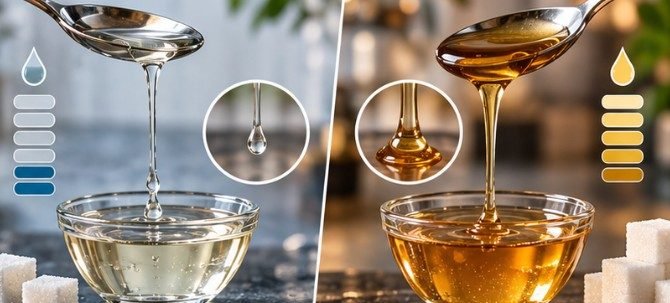
Doubling the sugar in simple syrup does not make a cocktail taste twice as sweet. That small piece of kitchen chemistry is what makes rich simple syrup vs regular simple syrup more interesting than a basic 2:1-versus-1:1 comparison.
Regular simple syrup is lighter, easier to measure, and adds more water along with its sweetness. Rich syrup is denser, more concentrated, and lets a bartender deliver similar sweetness with a smaller pour. That changes not only flavor but also texture, dilution, storage behavior, and the final balance of a drink.
The Core Difference Is Sugar Concentration
Regular simple syrup is traditionally made with one part granulated sugar and one part water. Rich simple syrup usually doubles the sugar, using two parts sugar for every one part water.
For repeatable results, measuring by weight is better than measuring by cups. Granulated sugar and water have very different densities, so a “cup-for-cup” recipe is not chemically identical to a gram-for-gram recipe.
A reliable home formula is simple: use 100 grams of sugar with 100 grams of water for regular syrup. For rich syrup, use 200 grams of sugar with 100 grams of water.
That means regular syrup is approximately 50% sugar by weight before considering minor changes from heating and evaporation. A 2:1 rich syrup is roughly 66.7% sugar by weight.
The same underlying principle in its guidance on food syrups for canning fruit: increasing the proportion of sugar produces progressively heavier, more concentrated syrups.
| Feature | Regular Simple Syrup | Rich Simple Syrup |
| Typical ratio | 1:1 sugar to water | 2:1 sugar to water |
| Sugar concentration by weight | About 50% | About 66.7% |
| Texture | Thin, easily pourable | Thicker and more viscous |
| Relative sweetness per equal serving | Lower | Roughly 1.3–1.5× stronger |
| Water added to a drink | More | Less |
| Best fit | Shaken drinks, iced tea, lemonade | Spirit-forward cocktails, concentrated drinks |
| Refrigerated keeping quality | Shorter | Generally longer |
Why Rich Syrup Is Not Simply “Twice as Sweet”
The phrase “twice the sugar” can be misleading.
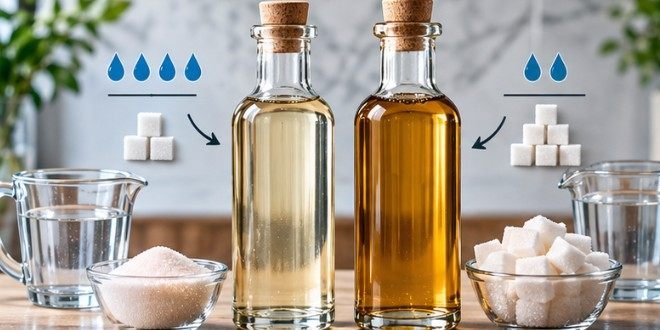
A rich syrup recipe contains twice as much sugar relative to its water, but the finished mixture also has greater total mass and density. Equal fluid ounces of the two syrups therefore do not represent a simple twofold sweetness difference.
In practical bartending, rich syrup is commonly treated as approximately one-third to one-half sweeter than standard syrup.
That is why replacing one ounce of regular syrup with one ounce of rich syrup usually makes a drink noticeably too sweet.
A Better Substitution Rule
If a recipe calls for 1 ounce of standard syrup, begin with about ⅔ ounce of rich syrup. Taste the finished drink before reducing further.
Going directly to ½ ounce can work in some cocktails, especially those containing naturally sweet liqueurs, but it is not a universal conversion.
The opposite substitution also works. If a recipe specifies ½ ounce of rich syrup and only regular syrup is available, roughly ¾ ounce of regular syrup is a sensible starting point.
Taste remains the final test because citrus acidity, alcohol strength, bitterness, temperature, and other sweet ingredients all change perceived sweetness.
Texture Is the Difference People Often Miss
The most useful distinction in rich simple syrup vs regular simple syrup may actually be mouthfeel.
Rich syrup flows more slowly and gives drinks slightly more body. That can be valuable in an Old Fashioned or another short, spirit-forward cocktail where a bartender wants sweetness without adding much extra water.
Regular syrup disappears into a drink more quietly. Its lower viscosity makes it especially convenient for iced tea, lemonade, coffee drinks, punches, shaken cocktails, and recipes where plenty of dilution is already desirable.
Neither texture is automatically superior. The correct syrup depends on what the drink needs.
Rich Syrup Can Reduce Unwanted Dilution
Imagine two cocktails that need roughly the same sweetness.

One receives a larger measure of 1:1 syrup. The other receives a smaller measure of concentrated rich syrup.
The second drink gets less added water from the sweetener itself. That can matter in cocktails served over a large ice cube or without much additional mixer, where a few fractions of an ounce can noticeably affect intensity.
In a long drink filled with sparkling water, tea, juice, or crushed ice, the dilution difference is usually much less important.
This gives home bartenders a simple decision test: if maintaining concentration and body matters, consider rich syrup. If easy measuring and lighter sweetness matter more, standard syrup is usually simpler.
Does Rich Simple Syrup Really Last Longer?
Generally, yes—but shelf-life claims need context.
Higher sugar concentrations can make microbial growth more difficult. MIchigan University notes in syrup-preservation guidance that concentrations below approximately 66% sugar can permit microbial growth under storage conditions, while excessive concentration can encourage crystallization.
A 2:1 syrup made accurately by weight lands close to that 66% level, which helps explain why rich syrup usually keeps better than a 1:1 syrup.
You may see general recommendations suggesting refrigerated regular syrup lasts around one month while rich syrup can last several months. Those are useful quality estimates, not guarantees.
Home preparation is not sterile. Dirty bottles, repeated opening, contaminated spoons, fruit residue, herbs, spices, and inaccurate ratios can shorten storage dramatically.
University of Minnesota Extension also makes an important broader point: sugar syrup should not automatically be treated as a food-safety control.
The Safer Home-Bar Method
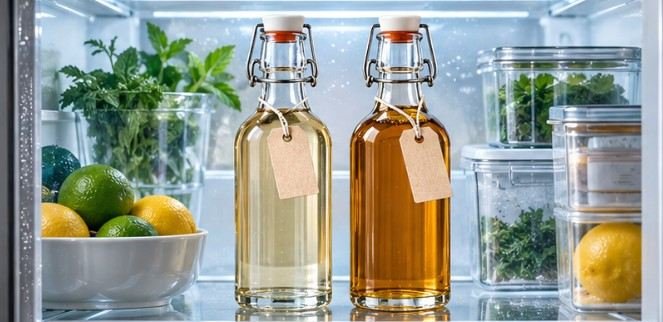
Use a clean container, prepare the syrup with clean utensils, cool it promptly, refrigerate it, and label the bottle with the preparation date.
Discard plain syrup if you notice visible mold, fermentation, unexpected bubbling, a clearly abnormal odor, or other signs of spoilage.
Flavored syrups deserve even more caution. Adding berries, citrus peel, herbs, fresh ginger, or other ingredients changes their microbial environment, so their storage behavior should not be assumed to match plain sugar-and-water syrup.
How to Make Both Syrups Without Overcooking Them
Simple syrup does not require aggressive boiling.
For regular syrup, combine equal weights of sugar and water. Warm gently while stirring until the crystals disappear.
For rich syrup, use two parts sugar to one part water and apply moderate heat while stirring. Because the solution contains much more sugar, dissolving may take slightly longer.
Avoid prolonged boiling. Evaporating too much water changes the concentration you carefully measured, and an excessively concentrated syrup becomes more prone to crystallization.
For both versions, transfer the finished syrup to a clean bottle after preparation and refrigerate once cooled.
What About Calories and Added Sugar?
Using less rich syrup does not automatically make a drink low in sugar. What matters is how much actual sugar ends up in the serving.
The FDA classifies sugars from syrups used in foods and drinks as added sugars and lists a Daily Value of 50 grams based on a 2,000-calorie diet. The American Heart Association uses a more restrictive recommendation, advising most women to stay near 6 teaspoons of added sugar daily and most men near 9 teaspoons.
CDC guidance also identifies sweetened beverages, including coffee and tea drinks, as important contributors to added sugar intake in the U.S.
That does not make simple syrup inherently problematic, but it makes portion size worth noticing—particularly when several sweet ingredients appear in the same drink.
Frequently Asked Questions
1. Is rich simple syrup twice as sweet as regular simple syrup?
No. It contains twice as much sugar relative to water, but equal servings are generally closer to about 1.3–1.5 times as sweet because the finished syrups have different concentrations and densities.
2. Can I substitute rich syrup for regular simple syrup?
Yes. Start with roughly ⅔ ounce of rich syrup for every 1 ounce of regular syrup, then adjust according to the other ingredients and your preferred sweetness.
3. Does rich simple syrup need refrigeration?
Yes. Refrigeration is the sensible approach for homemade syrup. High sugar concentration can slow microbial growth, but homemade rich syrup should not automatically be considered shelf-stable.
4. Why did my rich simple syrup crystallize?
Crystallization may occur when the syrup becomes overly concentrated, water evaporates during prolonged boiling, or sugar crystals remain around the bottle or pan and encourage additional crystals to form.
The Takeaway
The decision between rich simple syrup vs regular simple syrup is really a decision about concentration. Regular syrup gives you an easy 1:1 formula, lighter body, and straightforward measuring. Rich syrup delivers more sweetness in less liquid while adding viscosity and reducing dilution.
For most recipes, there is no reason to declare one universally better. Think about the drink instead. A tall iced beverage may benefit from standard syrup, while a compact whiskey cocktail may work beautifully with rich syrup. Measure by weight, substitute gradually, refrigerate homemade batches, and taste before assuming a mathematical conversion has created perfect balance.
Leave a Reply