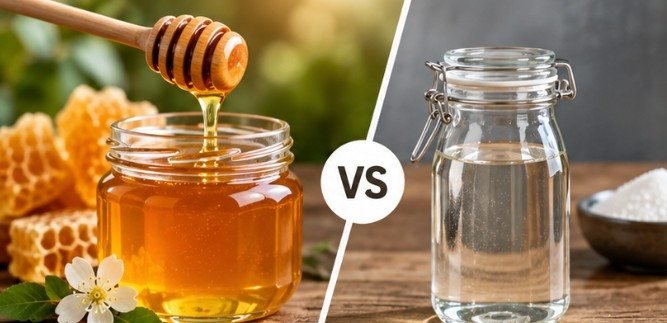
A half-ounce of sweetener can change far more than the sweetness of a drink. Simple syrup usually stays in the background, while honey syrup can add floral, earthy, fruity, or almost caramel-like notes before you change a single other ingredient.
That difference is the heart of honey syrup vs simple syrup. Both solve the same practical problem—getting sugar into a drink without leaving crystals or sticky honey at the bottom—but they behave very differently once flavor, concentration, temperature, and the rest of the recipe enter the picture.
For cocktails, iced tea, coffee, lemonade, and alcohol-free drinks, choosing the right one is less about which sweetener is “better” and more about whether you want sweetness to disappear or become part of the flavor.
Honey Syrup and Simple Syrup Are Not the Same Thing
Classic simple syrup is usually made by dissolving granulated white sugar in water. A common home and bar formula is equal parts sugar and water, although richer versions use more sugar.
Honey syrup follows the same basic idea but starts with honey. Instead of forcing thick honey into an ice-cold drink, you dilute it with warm water until it pours and measures easily.
The chemistry behind honey also explains why the result tastes different. Penn State Extension describes honey as a supersaturated solution composed primarily of glucose and fructose, with roughly 18% water. Its sugar balance varies with the flowers visited by the bees.
That natural variability is part of honey syrup’s appeal. Clover honey can be relatively gentle, while buckwheat or darker wildflower honeys may contribute considerably stronger aromas.
Honey Syrup vs Simple Syrup at a Glance
| Feature | Honey syrup | Simple syrup |
| Base ingredient | Honey and water | Granulated sugar and water |
| Flavor | Floral, fruity, earthy or robust | Clean and relatively neutral |
| Best role | Sweetener plus flavor ingredient | Primarily sweetness and balance |
| Cold-drink mixing | Good once diluted | Excellent |
| Consistency | Varies with honey and ratio | Highly predictable |
| Useful pairings | Whiskey, gin, citrus, tea, spices | Nearly any cocktail, coffee or lemonade |
| Cost | Usually higher | Usually inexpensive |
| Nutritional advantage | Small amounts of minor compounds, but still primarily sugar | Primarily sucrose and water |
The important point is that honey syrup is not simply “natural simple syrup.” It changes the sensory structure of the drink in ways ordinary sugar generally does not.
Why Bartenders Turn Honey Into Syrup
Dropping a spoonful of honey directly into warm tea works because heat lowers its viscosity and encourages it to disperse.
An iced cocktail is a different environment. Straight honey can stick to a jigger, cling to the glass, or remain concentrated in one part of the drink. Adding water first creates a more workable ingredient.
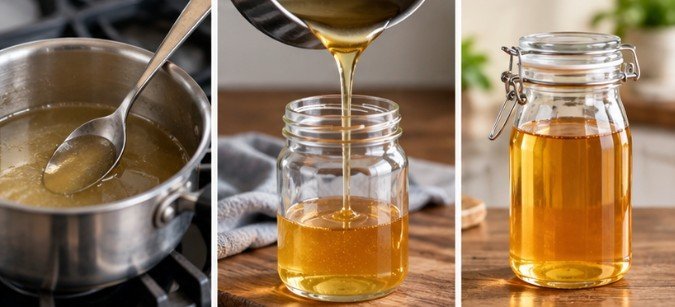
A 1:1 Honey Syrup
Combine one part honey with one part warm water and stir until completely uniform. This produces a relatively loose syrup that incorporates easily into iced drinks. It is useful when you want honey flavor without overwhelming the recipe.
A 2:1 Honey Syrup
Use two parts honey to one part warm water when you want a richer syrup with greater honey intensity. Because different honeys vary in moisture, flavor, and perceived sweetness, recipes should be treated as starting points rather than universal mathematical substitutions.
Avoid aggressively boiling good honey just to make syrup. Warm water is normally enough to dissolve and thin it, while excessive heating can mute some of the aromas you bought the honey for in the first place.
Flavor Is the Biggest Difference
Simple syrup has one major advantage: predictability.
It softens acidity, balances alcohol, and adds sweetness without contributing a recognizable new flavor. That is useful in drinks where strawberry, mint, coffee, citrus, or a particular spirit should remain the dominant note.
Honey syrup behaves more like another ingredient.
A Bee’s Knees works because gin, lemon, and honey reinforce one another. In a Gold Rush-style whiskey drink, honey can complement vanilla, oak, citrus, and baking-spice notes. It can also give iced black tea or lemonade noticeably more character than white sugar.
The same strength can become a weakness. A powerful honey may cover delicate cucumber, subtle floral spirits, light green tea, or gently flavored coffee.
If you want the drink to taste sweeter but otherwise essentially unchanged, simple syrup is normally the easier choice.
Is Honey Syrup Healthier Than Simple Syrup?
This is where marketing often gets ahead of nutrition science.
Honey can contain small amounts of minerals and other compounds, and its composition is more complex than refined table sugar. But a spoonful of honey syrup should not be treated like a meaningful vitamin or antioxidant supplement.
For nutrition-label purposes, the U.S. Food and Drug Administration includes honey and syrups within its definition of added sugars. Daily Value for added sugars is 50 grams on a 2,000-calorie diet.
Utah State University Extension similarly lists honey among common sources of added sugar.
The practical lesson is simple: changing a cocktail from simple syrup to honey syrup changes the flavor much more meaningfully than it changes the basic fact that the drink contains concentrated sugar.
Calorie comparisons can also be misleading unless the syrup concentrations and serving sizes are identical. A rich honey syrup and a thin simple syrup cannot fairly be compared tablespoon for tablespoon without accounting for how much actual sweetener each contains.
The Two-Glass Test for Choosing the Right Syrup
If I am developing a drink, I prefer a small comparison rather than guessing.
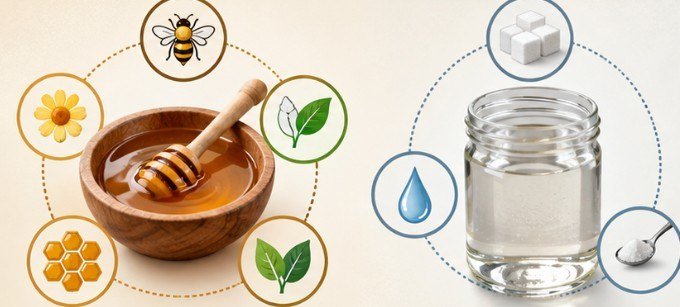
Make the unsweetened drink base first, then divide it equally between two glasses. Add the same small amount of simple syrup to one and honey syrup to the other—around 1/4 to 1/2 ounce is a reasonable testing range for many single drinks.
Taste both before adding more.
Ask three questions: Can I still taste the main ingredient? Does the sweetness balance the acidity or bitterness? Does the honey add a complementary flavor, or does it simply make the drink busier?
Then adjust in small increments.
This method works particularly well with whiskey sours, gin drinks, cold brew, iced black tea, lemonade, and fruit-forward mocktails because the flavor difference becomes immediately obvious.
Where Each Syrup Works Best
Simple syrup is especially useful when consistency matters. It is inexpensive, easy to reproduce, and adaptable to virtually any drink. It also makes sense when another strong flavor—such as passion fruit, berries, chocolate, or herbs—already has the spotlight.
Honey syrup is better when the sweetener should participate in the recipe. Try it with bourbon, rye, gin, lemon, ginger, cinnamon, black tea, chamomile, grapefruit, or apple. Darker honey generally works more comfortably with bold ingredients, while mild honey is safer for lighter drinks.
University of Minnesota Extension notes in its food-preservation guidance that mild-flavored honey can replace some granulated sugar in syrups, while also recognizing that different sweeteners change the finished product. That is essentially the same decision a drink maker faces: substitution affects more than sweetness.
Storage and Food-Safety Details Worth Knowing
Once water is added to a concentrated sweetener, it should not automatically be treated like the original shelf-stable jar of honey or bag of sugar.

For homemade drink syrups, use clean equipment, prepare manageable batches, keep the syrup covered, and refrigerate it rather than assuming it can remain indefinitely behind the bar or on the counter. Colorado State University Extension, for example, advises keeping prepared sugar syrup covered in the refrigerator when made ahead.
There is also one important exception involving honey itself. The CDC states that children younger than 12 months should not be given honey because it can contain bacteria associated with infant botulism. That warning applies to foods and drinks containing honey as well.
Frequently Asked Questions
1. Is honey syrup sweeter than simple syrup?
It can be, depending on the honey-to-water ratio. Honey composition also varies naturally, so equal volumes of two syrups do not necessarily deliver identical perceived sweetness.
2. Can I replace simple syrup with honey syrup 1:1?
You can start that way, but taste before finishing the drink. Honey contributes additional flavor and may require changes to the syrup, citrus, or other ingredients.
3. Why not put regular honey directly into a cocktail?
Thick honey disperses poorly in cold liquid. Diluting it with warm water creates a syrup that measures, pours, shakes, and mixes much more consistently.
4. Is honey syrup healthier than simple syrup?
Not in a way that makes either an unlimited sweetener. Honey contains additional compounds, but both contribute concentrated sugars and should be considered within overall added-sugar intake.
The Better Syrup Depends on What You Want to Taste
The most useful way to settle Honey syrup vs simple syrup is to stop thinking of them as interchangeable bottles of sweetness. Simple syrup is valuable because it is quiet: it balances a drink and then largely gets out of the way. Honey syrup earns its place by doing the opposite.
Use simple syrup when precision and neutrality matter. Reach for honey syrup when floral character, depth, and a stronger connection between the sweetener and the other ingredients can improve the drink.
That half-ounce may look minor in the measuring cup, but in the finished glass, it can determine the entire direction of the recipe.
Leave a Reply