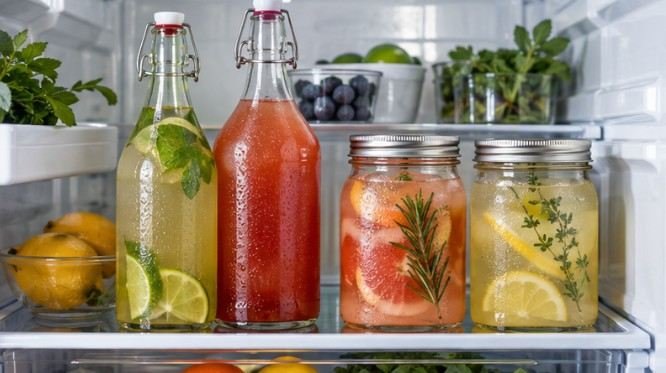
A pitcher of Margaritas and a bottle of pre-mixed Old Fashioneds may both be “batched cocktails,” but their refrigerator lives are completely different. Fresh citrus can lose its best flavor within days, while a high-proof mixture of spirits, sugar, and bitters can remain in good condition for weeks.
So, how long do batched cocktails last in the fridge? In practical terms, expect anywhere from about two days to several weeks. The deciding factor is not the cocktail name. It is the most perishable ingredient inside the bottle.
That distinction matters whether you are preparing drinks for a backyard party, holiday dinner, wedding, or simply trying to avoid wasting leftover cocktails.
The Short Answer: Shelf Life Depends on What You Batched
Wondering how to build a cocktail menu for a party? Most home batches fall into four broad categories.
| Batched cocktail type | Practical refrigerator window | Main limiting factor |
| Fresh citrus or fresh juice cocktails | About 2–3 days for best quality | Oxidation and flavor deterioration |
| Vermouth or wine-based cocktails | Roughly 1–2 weeks for best flavor | Wine oxidation |
| Spirit-forward batches | About 2–4 weeks or longer | Ingredient quality rather than rapid spoilage |
| Egg or dairy cocktails | Usually 2–4 days or less | Perishable ingredients and food safety |
These are planning ranges rather than universal expiration dates. Recipes, alcohol concentration, contamination during preparation, refrigeration temperature, and individual ingredients can all shorten usable storage time.
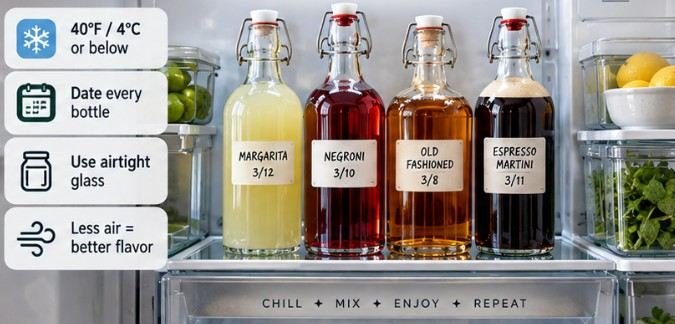
The U.S. Food and Drug Administration recommends keeping refrigerators at or below 40°F (4°C). FDA food storage guidance That temperature slows microbial growth but does not magically preserve every ingredient indefinitely.
Why Fresh Citrus Sets Such a Short Clock
Fresh lime, lemon, grapefruit, and orange juice are often the first ingredients to make a batch taste tired.
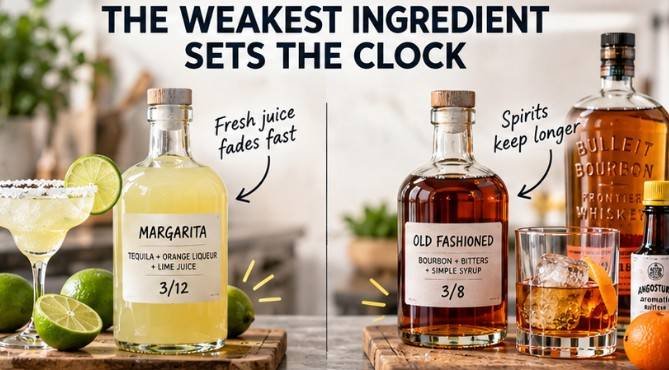
The problem is usually quality before obvious spoilage. Once citrus is squeezed, exposure to oxygen begins changing its aroma and flavor. A Margarita that tasted sharp and fragrant on Saturday may seem duller, harsher, or slightly bitter by Monday.
Professional batching guidance commonly limits cocktails containing fresh citrus to around two or three refrigerated days, with better results when the juice is added closer to service.
Acidity should not be confused with unlimited preservation. University of Minnesota Extension notes that lemon and lime juice are highly acidic, typically around pH 2.0–2.6, but fresh juice varies naturally.
For a party planned several days ahead, the better strategy is to batch tequila, orange liqueur, syrup, and any other stable ingredients first. Refrigerate that base, then add freshly squeezed lime shortly before serving.
Spirit-Forward Cocktails Are Much Better Batch Candidates
An Old Fashioned containing whiskey, sugar, water, and bitters behaves very differently from a Daiquiri containing rum and fresh lime.
There is less fresh organic material to deteriorate, and the alcohol concentration is generally higher. Properly bottled spirit-forward cocktails can therefore hold their flavor for weeks, especially when kept cold, sealed, and protected from excess air.
Negronis, Manhattans, Boulevardiers, and Martinis require one extra consideration: vermouth.
Vermouth is fortified wine rather than a shelf-stable distilled spirit. Once opened, refrigeration slows oxidation, but its delicate aromas gradually fade. Industry guidance commonly treats roughly two weeks as a strong peak-freshness target and around a month as a reasonable outer quality window for refrigerated opened vermouth.
That means the vermouth, not the whiskey or gin, usually determines how long the finished batch tastes its best.
Dairy and Eggs Require a Different Standard
A creamy holiday punch cannot be judged by the same rules as a bottled Martini.
Milk, cream, and eggs are perishable foods. The FDA advises storing dairy products at 40°F or below and following their refrigerated storage requirements closely.
USDA storage guidance lists homemade eggnog at approximately two to four days in the refrigerator and commercial eggnog at roughly three to five days.
For homemade flips, eggnog-style punches, and cream cocktails, I would therefore prepare them much closer to serving than a spirit-forward batch. Using pasteurized egg products where appropriate also reduces risk associated with raw eggs.
Use the “Weakest Ingredient” Test Before You Batch
Instead of memorizing dozens of cocktail-specific timelines, use a four-step check.
1. Find the most perishable ingredient
Look for fresh juice, fruit purée, dairy, eggs, fresh herbs, opened wine, vermouth, or other refrigerated ingredients.
The finished cocktail cannot reasonably be expected to remain fresher than its weakest component.
2. Separate safety from flavor
A drink can taste worse before it becomes obviously unsafe.
Colorado State University Extension notes that oxidation can create rancid flavors and that fruit juices can undergo fermentation from yeast growth. It also warns that appearance and odor alone cannot always tell you whether a food contains unsafe levels of bacteria.
That is why “it smells fine” is not a reliable preservation strategy.
3. Check your refrigerator temperature
Use an appliance thermometer rather than assuming the refrigerator is cold enough. A batch sitting at 36°F is being stored under very different conditions from one repeatedly warming above 40°F because of a crowded refrigerator or frequently opened door.
4. Date every bottle
Write the preparation date directly on a label or piece of tape. For event batches, also note what still needs to be added: “Add lime Friday,” “Add soda at service,” or “Garnish only after pouring.” This takes seconds and prevents surprisingly common mistakes.
What Should Stay Out Until Serving?
Several ingredients are better treated as finishing components.

Fresh citrus is the obvious example. Carbonated ingredients such as club soda, tonic, sparkling wine, or ginger beer should also usually be added at service because storing them in the batch sacrifices carbonation.
Fresh garnishes should remain separate as well. Cut fruit is perishable and should stay refrigerated in a sealed container. Penn State guidance for handling fresh produce recommends promptly refrigerating cut or perishable produce and discarding produce showing spoilage.
A useful hosting method is therefore to pre-batch the stable “core” and leave juice, bubbles, dairy, and garnishes for later.
Can You Freeze Batched Cocktails?
Sometimes—and spirit-forward cocktails are the best candidates.
Gin, vodka, whiskey, rum, liqueurs, syrups, bitters, and measured dilution water can often be combined and kept extremely cold without major quality problems. Higher-proof Martini-style batches are especially popular for freezer storage.
Lower-alcohol mixtures containing substantial vermouth, juice, or water can partially freeze or become slushy. Extremely cold temperatures can also mute aroma and flavor.
Freezing should also not be viewed as sterilization. Federal food-safety guidance notes that freezing stops microbial growth but does not necessarily destroy harmful microorganisms.
For long-term freezing of citrus juice itself, Colorado State University Extension reports that citrus fruits and citrus juices can maintain good freezer quality for roughly four to six months at 0°F.
Common Batch-Cocktail Storage Mistakes
One of the biggest mistakes is assuming the alcohol preserves everything in the bottle. Adding tequila to fresh lime juice does not reset the lime juice’s freshness clock.
Another is storing a half-full batch in a large pitcher. Greater air exposure encourages oxidation. A clean glass bottle or jar with a tight-fitting lid and minimal empty headspace is usually a better choice.
Finally, do not keep returning unused cocktail from serving pitchers to long-term storage. Ice, garnishes, hands, utensils, and room-temperature exposure all complicate the original storage assumptions.
Frequently Asked Questions
1. How long do Margaritas last in the fridge?
A Margarita containing fresh lime juice is best consumed within about two to three days. For longer advance preparation, refrigerate the tequila-and-liqueur base and add fresh citrus shortly before serving.
2. How long do batched cocktails last in the fridge if they contain only spirits?
Spirit-forward mixtures can maintain good quality for several weeks when refrigerated in a clean, airtight bottle. Vermouth, wine, fresh ingredients, and dilution can shorten that window.
3. Can I batch cocktails a week before a party?
Yes, if you batch only stable ingredients. Prepare spirits, liqueurs, bitters, and syrups ahead, then add fresh juice, carbonation, dairy, eggs, and delicate garnishes closer to serving.
4. Should batched cocktails be stored in glass or plastic?
Clean, tightly sealed glass bottles are an excellent option because they reduce air exposure and do not absorb odors easily. Food-safe plastic containers can also work for shorter storage.
A Better Rule Than Memorizing Expiration Dates
The useful answer to how long do batched cocktails last in the fridge is not one fixed number. A fresh-juice punch may have only a few excellent days, while a sealed, spirit-heavy batch can stay enjoyable far longer.
I would plan every batch backward from its most fragile ingredient. Bottle the stable ingredients early, keep the refrigerator at 40°F or below, label the preparation date, and save fresh citrus, bubbles, eggs, dairy, and garnishes for as late as practical. That approach preserves more than shelf life—it preserves the reason you batched the cocktail in the first place: serving a drink that still tastes intentional.
Leave a Reply