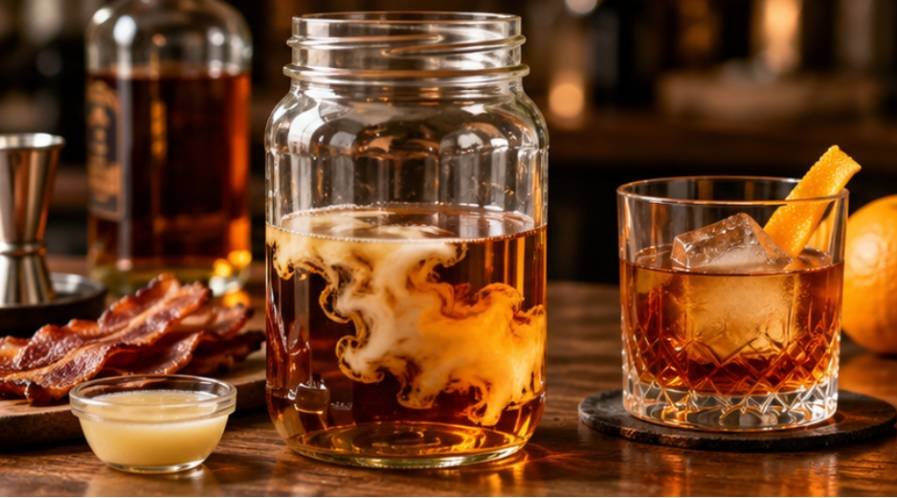
The strange thing about fat-washing is that the finished spirit should not taste oily. Done correctly, bacon fat, brown butter, coconut oil, or sesame oil leaves behind aroma while most of the actual fat is removed. That makes fat washed cocktails for beginners less intimidating than the name suggests: it is essentially an infusion followed by chilling and filtration.
It captures flavors simple syrup cannot. Smoke, browned butter, toasted nuts, and savory oils carry aromas that do not translate cleanly into sugar-and-water mixers.
What Fat-Washing Actually Does
Fat-washing became a signature modern-bar technique after Don Lee’s Benton’s Old Fashioned at PDT in New York helped popularize bacon-washed bourbon.
Ethanol has both polar and nonpolar characteristics. An American Chemical Society study on ethanol-water mixtures describes ethanol as containing both polar and nonpolar regions, an important clue to why it can interact with a broad range of flavor compounds. The NIH PubChem profile for ethanol also lists ethanol as miscible with water and compatible with numerous organic solvents.
That matters because a spirit can pick up aromatic compounds associated with a flavorful fat. Chilling then hardens much of the fat so it can be removed. What remains is not “liquid bacon grease,” but a spirit with a changed aroma profile.
The technique will not copy every taste of the original ingredient. Salt and sugar behave differently from fat-soluble aroma compounds, so bacon-washed whiskey can smell smoky without tasting as salty as bacon.
The Beginner Ratio: Test Five Ounces, Not a Bottle
A full 750-milliliter bottle is a poor first experiment. Start with 5 ounces of spirit. A practical upper starting point is about 1 ounce of melted fat to 5 ounces of spirit, then scale downward for aggressive ingredients.
Campari Academy says its team often works around 15% to 20% infusion material relative to spirit, while noting that the ideal amount changes with the fat source. One ounce of coconut oil is far milder than one ounce of toasted sesame oil.
If the fat smells powerful on its own, begin closer to 1/2 ounce per 5 ounces of spirit.
| Fat | Beginner spirit | Starting amount per 5 oz spirit | Likely result |
| Brown butter | Bourbon or rye | 0.75–1 oz | Nutty, caramel-like |
| Coconut oil | Rum | 0.75–1 oz | Soft tropical aroma |
| Bacon fat | Bourbon | 0.5–0.75 oz | Smoky, savory |
| Olive oil | Vodka or tequila | 0.5–0.75 oz | Grassy, rounded |
| Toasted sesame oil | Gin or vodka | 0.25–0.5 oz | Intense roasted aroma |
A Reliable First Batch in Five Steps
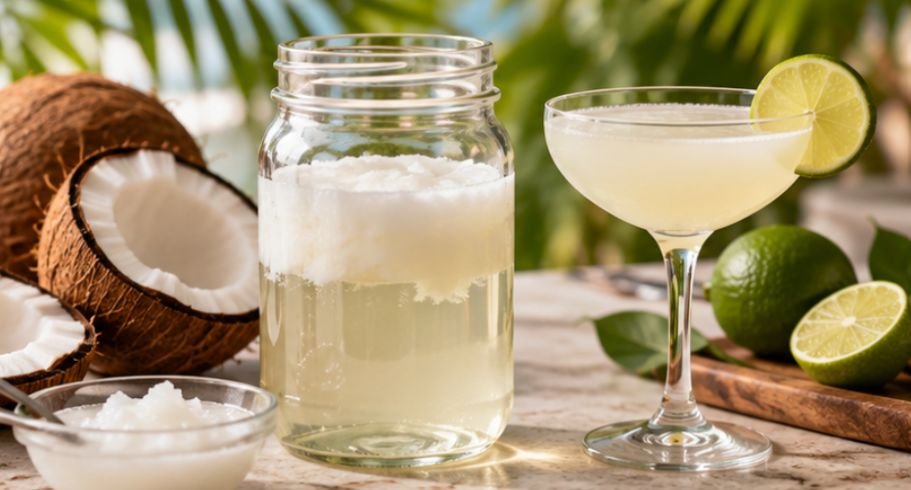
For fat washed cocktails for beginners, consistency matters more than novelty. Use a clean glass jar, measured ingredients, a freezer, a fine strainer, and a coffee filter.
- Melt or render the fat gently. Brown butter should smell nutty, not burnt. Bacon fat should come from fully cooked bacon and be strained free of food particles.
- Combine the fat and spirit in a clean jar. Seal and shake for 15 to 20 seconds so the phases make broad contact.
- Infuse for about two hours as a first test, then taste a small sample. The USDA Food Safety and Inspection Service advises that perishable foods should not remain at room temperature beyond two hours, or one hour when temperatures exceed 90°F.
- Freeze until the fat is fully solid. Overnight is convenient and usually produces a firm cap.
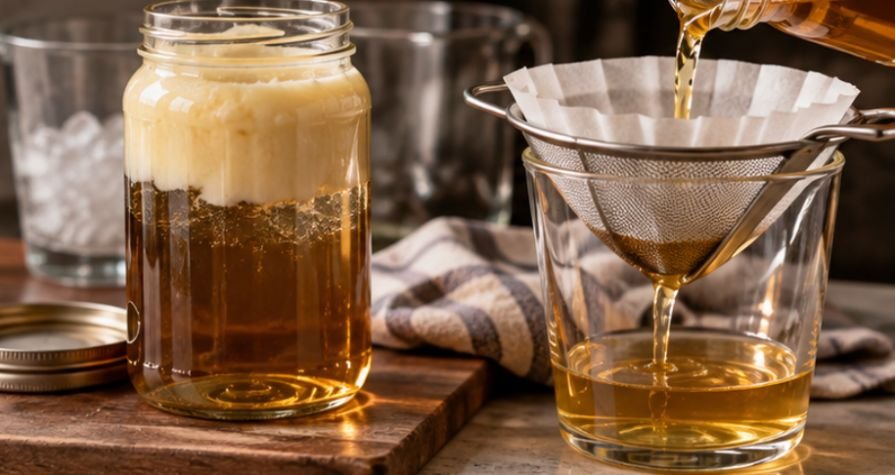
- Remove the solid fat, strain the spirit, then pass it through a coffee filter. If oil droplets remain, chill and filter again.
Troubleshooting Cloudiness and Weak Flavor
Cloudiness usually means tiny fat droplets survived the first separation. Freeze the batch again and filter slowly through paper.
Filtration is also central to other clarified cocktail techniques, including clarified milk punch for beginners, where a curd bed helps remove suspended particles.
More heat is not the answer; you want the fat solid enough to remove.
Weak flavor usually means the fat was too mild, the ratio too low, or the infusion too short. Change one variable in the next batch so you know what improved the result.
Discard a batch that smells stale, waxy, or paint-like. Penn State Extension’s guidance on edible oils explains that oils can oxidize and form compounds associated with rancidity and undesirable flavors. Cooler, protected storage can help slow quality loss.
Three Easy Cocktails That Reveal the Difference
An Old Fashioned is a clear test for brown-butter- or bacon-washed bourbon because only sugar, bitters, and citrus peel stand between you and the altered whiskey.
Serve the drink in the right glass as well; an Old Fashioned is one of the classic drinks where the appropriate glassware helps complete the presentation. See essential home bar glassware for beginners for the basic glasses worth keeping at home.
Coconut-washed rum works well in a Daiquiri with fresh lime and simple syrup; acidity keeps the richer aroma from feeling heavy. Olive-oil-washed vodka can work in a dry Martini, where grassy notes complement an olive garnish.
The idea is simple: use one changed ingredient in a stripped-down drink so you can judge whether the wash actually improved it.
Food Safety and Alcohol Strength Still Matter
Alcohol does not make careless food handling automatically safe. Use fresh, fully cooked fats; clean jars and tools; avoid putting raw meat into spirits; chill promptly; and refrigerate finished washes made with animal or dairy fats.
Fat-washing changes flavor, not drinking math. The National Institute on Alcohol Abuse and Alcoholism’s standard-drink guidance defines one U.S. standard drink as 0.6 fluid ounce, or 14 grams, of pure alcohol. About 1.5 ounces of 40% ABV distilled spirits equals one standard drink.
That point is easy to miss with a smooth fat-washed whiskey. A softer or rounder sensation does not mean the alcohol has disappeared.
What Beginners Often Misunderstand
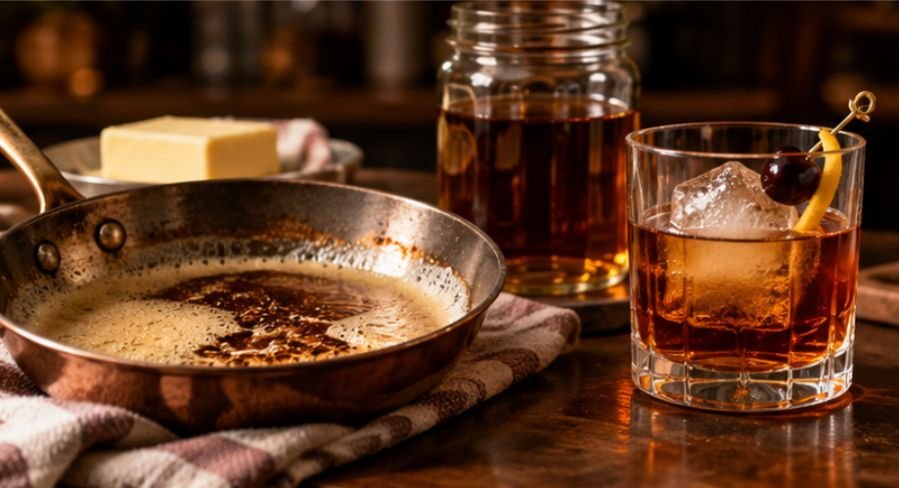
Fat-washing is not the same as adding butter or oil directly to a finished cocktail. Most of the bulk fat is removed before service.
It is also not automatically shelf-stable. Campari Academy specifically cautions that fat-washed infusions are not shelf stable. For home batches, keep quantities small, refrigerate when appropriate, and discard anything with an off odor.
Stronger is not always better. If the wash erases the base spirit, use less fat or shorten the contact time next round. The best version should still taste recognizably like bourbon, rum, tequila, gin, or vodka.
Frequently Asked Questions
1. Can I fat-wash vodka?
Yes. Vodka is a useful neutral base for olive oil, sesame, butter, or coconut experiments because fewer existing flavors compete with the infusion.
2. How long should a fat-washed spirit freeze?
Overnight is the easiest beginner rule. The goal is a hard, removable fat layer. If the spirit still looks oily, freeze longer and filter again.
3. Can I reuse the fat after washing?
Discarding it is the safer, more predictable home approach, especially with animal or dairy fats. It has contacted alcohol and may contain flavors pulled from the spirit.
4. Do fat-washed cocktails contain less alcohol?
Do not assume they do. Some liquid is lost during separation and filtration, but the finished spirit remains alcoholic and should be measured normally.
The Takeaway
The best first fat wash is not the wildest combination; it is the batch you can understand and repeat. Start with five ounces of a familiar spirit, a measured amount of fresh fat, a short infusion, a hard freeze, and careful filtration. Taste it beside the original spirit before mixing a drink.
That comparison turns a trendy bar trick into a usable technique. Once you recognize what brown butter does to bourbon or coconut does to rum, you can adjust ratios deliberately instead of guessing. The real skill is not adding fat. It is deciding exactly how much flavor to leave behind.
Leave a Reply